

Investigating People and the Planet
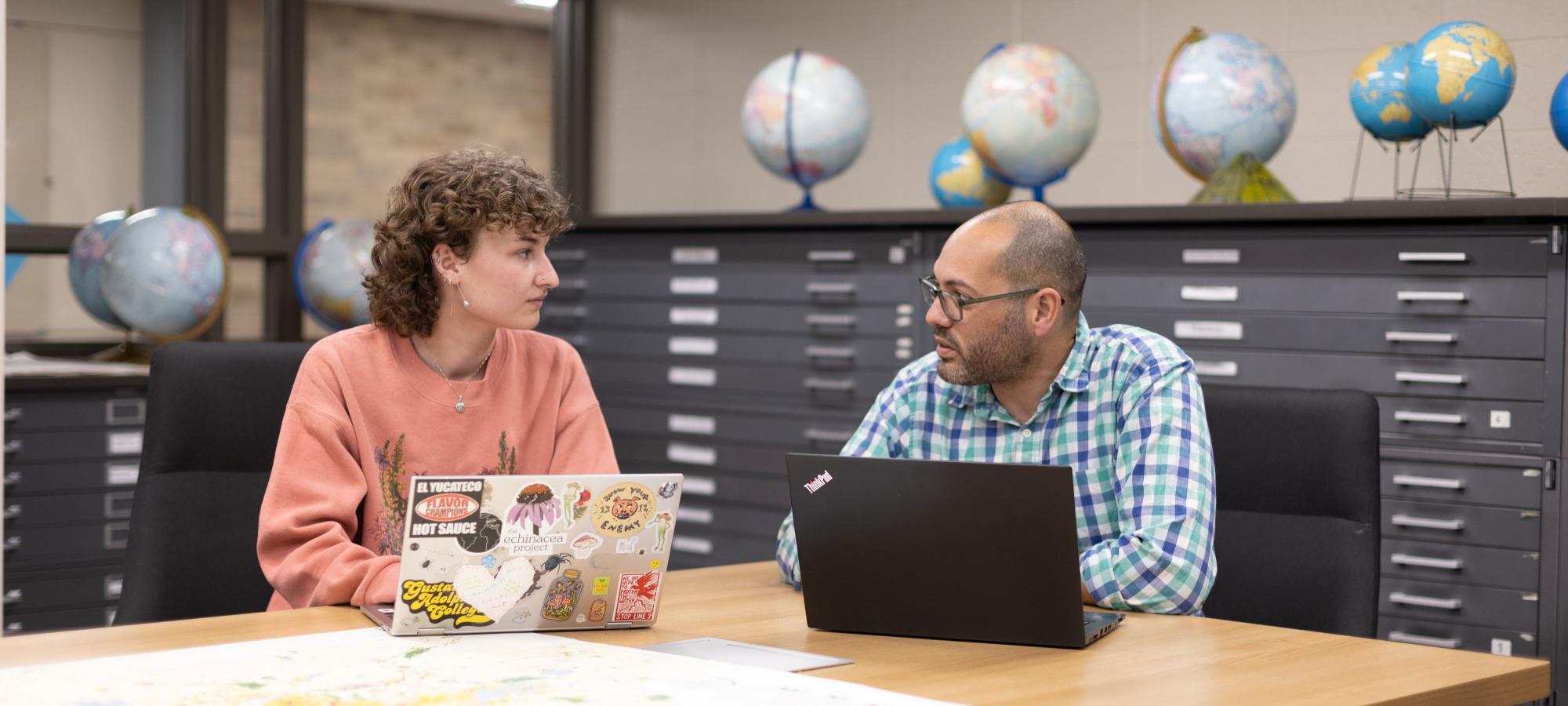
With a variety of majors and minors to choose from, you can customize your education to fit your interests and goals. Working with dedicated faculty, students learn in collaborative, inclusive classrooms, and also while conducting environmental research and taking field trips.
The Department of Environment, Geography, and Earth Sciences (EGE) at Gustavus is a place to explore your passions and build tangible skills to make a meaningful impact.
- Our community of diverse learners draws on natural and social sciences as well as arts and humanities to understand the Earth's environments (past and present) and how humans transform and experience the world around us.
- We study earth science, social systems, and the links between the two.
- We tackle challenges such as climate change, sustainable natural resource use, and urban planning while prioritizing justice and equity.
- We use mapping and spatial analysis to study conservation and land use.
Majors, Minors, and Related Programs
We unite the fields of Geography, Geology, and Environmental Studies into a single, interdisciplinary department to better understand our planetary home from a variety of perspectives. Students in the Department may pursue majors and minors in Environmental Studies (ES), Geography (GEG), or Geology (GEO), with opportunities to specialize in a track matching a student's interests.
As a part of the EGE community, you will be prepared to engage with some of the world's biggest challenges, such as responding to a rapidly changing climate, protecting ourselves from natural and human-created hazards, and building more just and equitable cities. How do we utilize energy and Earth's resources in an environmentally and socially sustainable way? How do various cultures view their relationship with the natural world, and how does that shape human cooperation and conflict? Come explore these and other big questions.
A Curious Community Exploring the World
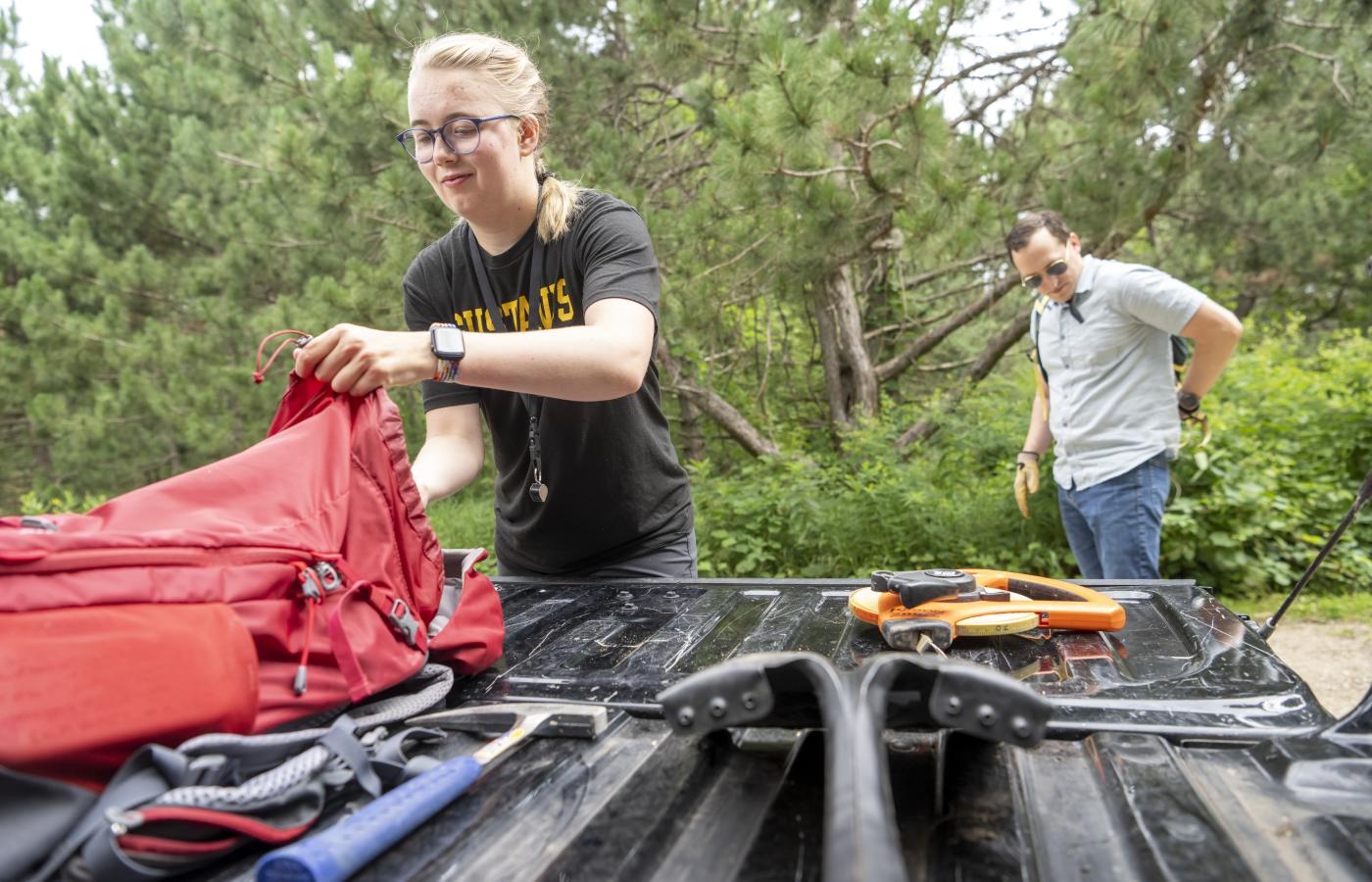
- Students and faculty in the Environment, Geography, and Earth Sciences Department enjoy experiential or "hands-on" learning.
- Field trips, research opportunities, study away, project-based learning, and laboratory experiences enrich learning and provide real-world training.
Opportunities in Environment, Geography, and Earth Sciences (EGE)
EGE Explores the World in Classrooms and Beyond
EGE at Gustavus you can apply your learning across campus and around the world. Recent opportunities have included participating in faculty-student research projects, helping implement a campus-wide composting program, creating and curating exhibits in the Geology Museum, and traveling to study glaciers in a unique collaboration between scientists and artists. Learn more about opportunities to grow in and out of the classrooms.
Research — Learn career-relevant techniques, work on teams to execute plans, and take the time you need to deep-dive on topics of interest.
Field Trips — Students and faculty regularly embark on off-campus excursions.
Learning Facilities and Instrumentation — The newly renovated Nobel Hall of Science is home to the classrooms, labs, and cutting-edge scientific equipment for advanced and comprehensive learning in EGE courses and majors related to the natural sciences. Also in Nobel Hall, the Environmental Studies Projects Lab gives students the interdisciplinary space and equipment to build, grow and create.
Study Away — Immerse yourself in another culture while also continuing with your academic studies.
Internships — This is an opportunity to apply academic learning in a professional setting that helps determine a career path.
Sustainability Interns — Provide significant leadership related to campus sustainability projects.
Student Community — There are regular activities to get to know the students and faculty in the department.
Student Awards — Student academic excellence in the classroom and research is annually honored.
The Arboretum — The 125-acre natural area on campus serves as an outdoor classroom and recreation space.
Careers and Graduate School — With support from the faculty and Career Development Center, you receive the resources you need, from first year through graduation.
Explore opportunities in Environment, Geography, and Earth Sciences
Local and Global Learning
As an Environment, Geography, and Earth Sciences student at Gustavus Adolphus College, you'll join a top program in the state with a wide range of study options. Located in the beautiful State of Minnesota, Saint Peter is in the Minnesota River valley. The Gustavus Adolphus campus is a perfect place to build close-knit relationships with proximity to big-city opportunities, museums, and internship sites. You're minutes away from the medium-sized city of Mankato and an hour from the dynamic Twin Cities of Minneapolis and St. Paul. Further north, you'll find majestic Lake Superior and the Boundary Waters Wilderness Area. The EGE Department prepares you to address significant challenges at the local and global levels.
Contact Environment, Geography, and Earth Sciences
Email: EGEdeptinfo [at] gustavus.edu (EGEdeptinfo[at]gustavus[dot]edu)
Phone: 507-933-7333
Department Chair: Anna Versluis
Nobel Hall of Science, 2145
800 West College Avenue
Saint Peter, MN 56082