

Discover the Opportunities with Environment, Geography, and Earth Sciences
Students from the EGE Department are some of the most engaged students on campus, eager to delve into learning opportunities outside their classes. Explore the numerous experiences to grow your environmental knowledge.
Student Community
Students in the EGE Department are active across campus, from student-led organizations to academic honor societies. Within the department we host:
- EGE FIKA - Join our community of faculty, staff, and students in the EGE Cafe each week for snacks and socializing. This is a regularly-scheduled and informal time for sharing experiences and getting to know other people who share your interests of conversation and connecting.
- Geology Club - A group of geologically and environmentally enthusiastic people who gather for fun and to learn more about our planet. We are not limited to Geology majors or minors and are open to anyone who is fascinated by the Earth. We welcome people of all backgrounds, genders, racial, and sexual identities!
Learning Spaces
Campus is the classroom
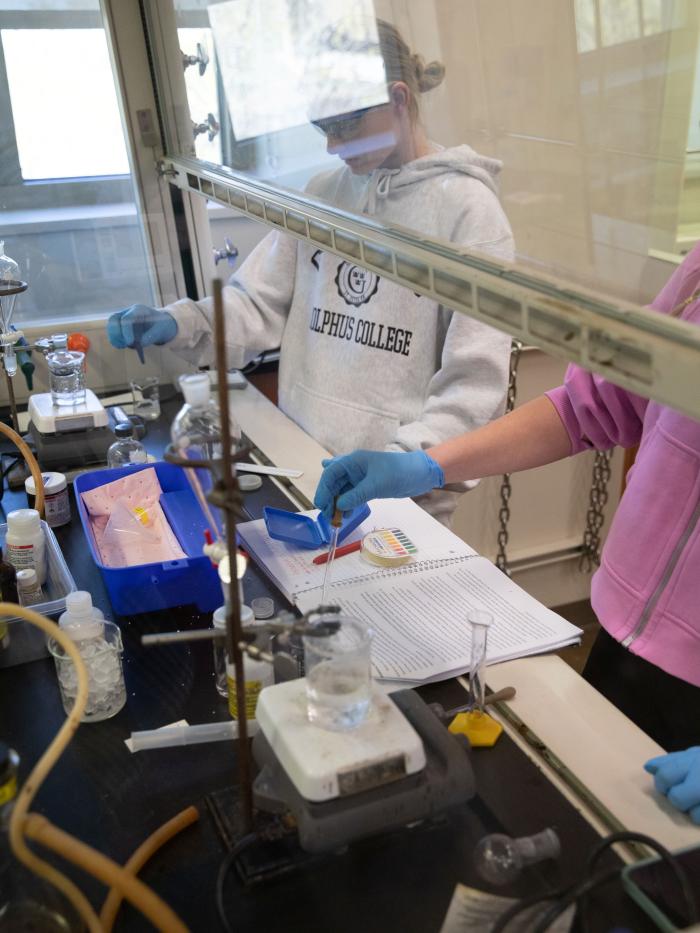
- Studying the earth and humanity requires many approaches, so EGE classrooms may be anywhere on campus and range from computer labs to discussion circles, art studios to science labs, and beyond
Facilities and Instrumentation
- The Nobel Hall of Science is a state-of-the-art, transdisciplinary facility that encourages students to collaborate everywhere, from student lounges and labs to the STEAMery Café
- The Geospatial Information Systems (GIS) teaching lab has state-of-the-art software to prepare you for careers in many GIS-intensive disciplines
- The Environmental Studies Student Projects Room is the space for you to explore and experiment! We have a variety of resources – from grow lights to power tools to sewing machines – to help you make your vision become reality
Chester Johnson Geology Museum
- The Chester Johnson Geology Museum is home to engaging student-made exhibits where visitors can explore natural history and geology
The Arboretum
- The Gustavus Arboretum celebrates Minnesota's natural history and provides learning opportunities for nature lovers of all ages. The Arboretum is adjacent to the main campus, which makes it also a great place to learn or just go to enjoy nature. Check out opportunities to work and volunteer at the Arb
Learning Outside the Classroom
Study Away
- Study away opportunities broaden horizons and expand perspective for students in the EGE Department, from sustainability studies in Denmark to globalization in India. Faculty work with students to plan how studying away can fit into a college experience. Explore faculty-led and independent international learning with the Center for International and Cultural Education Office.
Internships
- Many students in the EGE Department complete an internship to gain additional experience in a professional setting. Find out more about resources, connections, and future career paths with alumni connections across the country and from our Career Development Office.
Sustainability Interns
- You can make a difference by guiding eco-friendly practices on the Hill. Learn more about Sustainability at Gustavus and to support sustainability action at Gustavus as a Sustainability Intern.
Research
We regard research and projects as integral parts of our Department's educational program because they inspire creativity, teach rigorous thinking, and help students develop independence.
Environmental Studies majors design and execute senior projects on campus that promote environmental change in practice or in the community mindset. Recent projects have included: a greenhouse gas inventory for the City of St Peter, an inventory and GIS mapping of the over 1600 trees on campus (not including the Arboretum), planning and planting a prairie at Big Hill Farm, planning environmental justice events on campus with COPAL (Comunidades Organizando el Poder y la Acción Latina), and conducting environmental educational activities in local elementary schools
Geography majors take a Research Methods course at the sophomore level and conduct research within a senior capstone course. Recent capstone courses have included: Glaciers in a Warming World and Political Ecology
Geology majors conduct original research – often in collaboration with faculty at Gustavus or elsewhere – and write a senior thesis or technical report. Recent research topics and field experiences have included: determining the effects of war on soil development in central Europe; reconstructing the paleo-ecology of ancient ocean life from fossils; mapping past and potential future landslide locations in Minnesota.
Talk to your professors if you are interested. Also, the Office of Undergraduate Research and Fellowships Office have resources and staff to help you find an on- or off-campus opportunity.
Student summer research endeavors are usually paid and in conjunction with a faculty member at Gustavus, another college or university, or a government agency.
- Every summer, the Gustavus First-Year Research Experiences (FYRE) and Second-Year Experience at Research (SEAR) programs match interested first- and second-year students with faculty who are doing summer research in the realms of the natural sciences, psychological sciences, or math and computer science. Applications for this competitive program are due in late-February/early-March.
- Sometimes, individual EGE faculty members will have funding to hire one or more summer student collaborators. We recommend that in December or January you ask professors if they’ll be taking on summer students, and if so what their application process will be.
- Many EGE students with a natural science focus apply for paid National Science Foundation Research Experiences of Undergraduates (NSF-REU) summer internships at other colleges and universities. The project page is updated in December–January, and applications are due February–March.
- EGE students have also obtained summer research positions and internships at government agencies, private companies, and nonprofits. For government agencies, you can look everywhere from the local level (e.g., city watershed protection organizations, county parks) to the state level (e.g., Minnesota Department of Employment and Economic Development, Minnesota Department of Natural Resources) to the national level (e.g., U.S. Environmental Protection Agency, U.S. Department of Energy). You can ask your professors for more specific ideas.
Research opportunities vary each academic year (outside of regularly offered courses and major requirements that include research). Sometimes professors will offer a research course during May term. Other times, professors have funding to pay a student research assistant for a certain number of hours or work per week. Occasionally, a student will create an independent study course with the supervision and approval of a professor, wherein the student leads a research project.
Field Trips
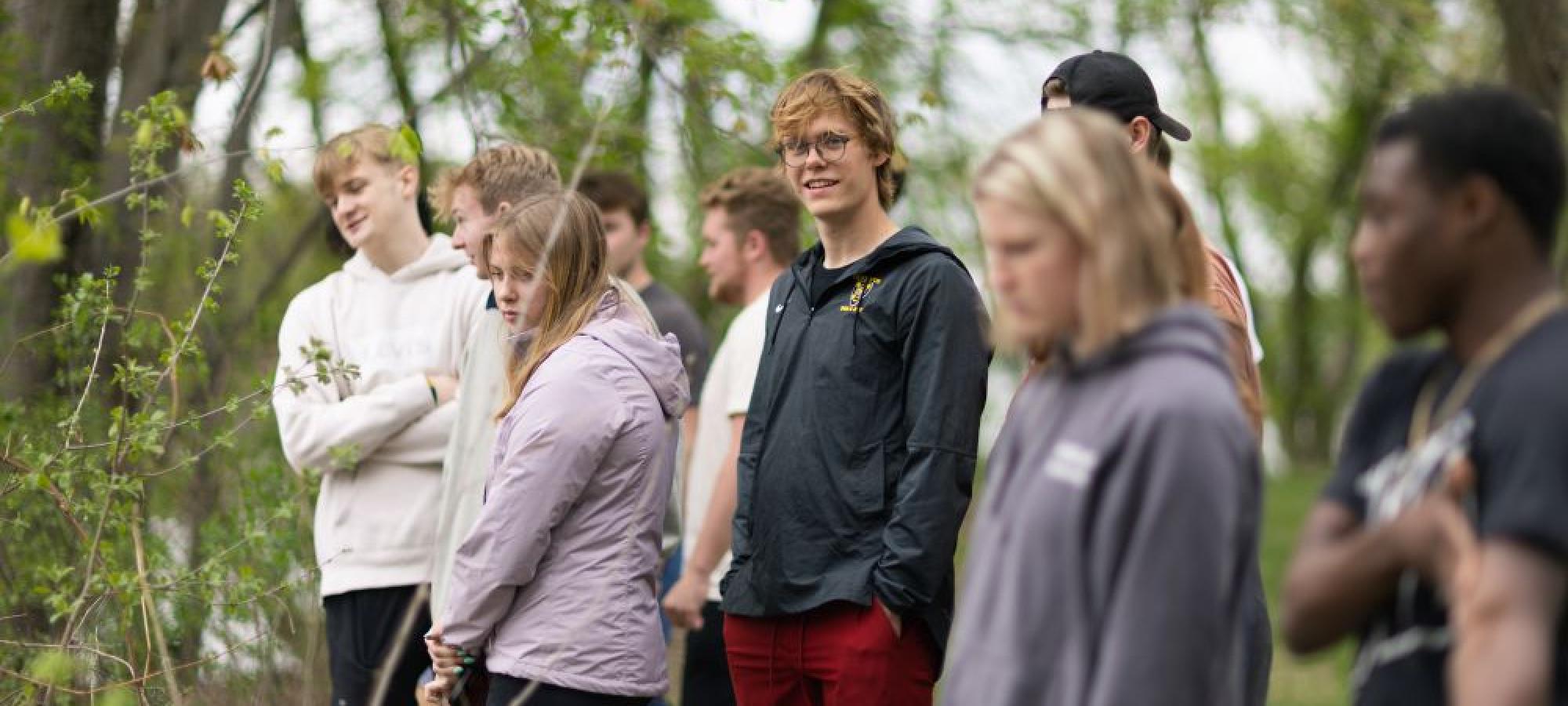
We love getting students outside of the classroom! We’ve found that some of the best learning experiences and social networking experiences happen when we leave campus together.
We strive to make field trips accessible to all students and will communicate early and often with class members to ensure that everyone feels safe and has what they need to maximize learning on field trips. Yes, it’s possible that you’ll feel nervous about a field trip beforehand! Any new experience can seem daunting, and for some students this might be well outside of your comfort zone. However, we ask you to be attentive to the difference between feeling unsafe versus feeling uncomfortable. We want to ensure that everyone feels safe! And, we recognize that sometimes the best growth – whether it’s as a student, or athlete, or artist, or as a human in general – comes when we’re outside our comfort zone.
Geology: Every introductory level course has field trips within the designated lab time, and almost every upper-level course has an overnight field trip so we can get further away from campus to see different geology. Recent destinations include water sampling at the Minnesota River, studying geomorphology along Lake Superior’s shoreline, and collecting fossils in Decorah, Iowa. The longest course-based field trip we offer is in GEO 262: Evolution of the Earth, which has a required spring break field trip to the American Southwest.
Geography: Some introductory courses have field trips within the designated lab time, and a few upper-level courses have day-long field trips. Recent destinations include Seven Mile Creek Park near campus, and the U.S. Immigration Court in Minneapolis.
Environmental Studies: Some core courses have field trips within the designated lab time, and a few upper-level elective courses (particularly those in the Earth Science and Life Science concentrations) have longer field trips. Recent destinations include canoeing on a local lake to collect water samples, and identifying plants at Kasota Prairie.
We’ve found that even students who’ve never yet slept in a tent, cooked a meal outdoors, or gone for a hike in the woods find these experiences meaningful and empowering. We will give you all the information and gear you need to succeed. We’ve had many first-time campers on our trips, and we’ve gotten tons of enthusiastic, positive feedback afterward! Most overnight field trips are associated with Geology (GEO) and Biology (BIO) courses.
Our Geology and Biology instructors have a lot of experience teaching “in the field.” If you are camping, we’ll make sure every student has a good sleeping bag, sleeping mat, and a tent situation that makes sense for them. We have a camp kitchen with stoves, pans, dishes, silverware, and cups for cooking and eating together “family style.” The class will help choose the meal plans, ensuring that everyone’s dietary needs are met, and the Department will purchase the food. We’ll usually assign small groups of students to cook each meal, under the supervision of the instructor if needed. Everyone will take a turn with doing dishes, and we’ll help teach you how to do that, too, if it’s new to you!
- We'll load up our College vans on a Friday afternoon after classes are over, then drive a few hours to a state park campsite.
- We'll set up the tents, cook dinner together, eat dinner, do dishes, then get an orientation to the area
- Often, students will hang out around the campfire for a while, or play cards or some other game, before heading to bed at a reasonable hour.
- In the morning, we’ll have a set time for breakfast so that everyone knows when to get up. We’ll make coffee, tea, and cocoa, have breakfast, take down the tents, and pack up the vehicles.
- We’ll head out to do some work! That might involve short hikes, collecting rocks, interviewing local residents, taking measurements, having discussions, learning from local experts, touring farms, etc.
- We’ll often have a picnic lunch at a park or scenic lookout, then continue doing work in the afternoon.
Careers and Graduate School
Alumni from the EGE Department have a rich history of advancing to ground-breaking careers and top graduate programs across the country and around the world. Explore future paths and possibilities for careers and graduate school.
The EGE Department encompasses three majors and several minors, which lead to many possible paths after Gustavus! In most years, about one-third of our graduates go directly to graduate school to seek a master’s or doctoral degree related to their major. About one-third of our graduates decide to enter the workforce in a job related to their major. And, about one-third of graduates decide to try something completely different after college; in this case, the competence and skill sets they’ve gained in their major courses are still very important contributors to post-college success.
More about graduate school
For some career paths, a graduate degree is either necessary or at least will give you a big advantage in getting the job you want. Graduate school is very different from college:
-
In some fields, like the natural sciences, the university will pay your tuition, health insurance, and a modest salary in exchange for you working in a research lab or helping teach a course while you complete your studies. In other fields, you may be expected to pay more of the costs.
-
You usually take fewer courses in a semester.
-
You spend a large portion of your time doing research and creating your own ideas, data, writing, and/or artistic creations (depending on the field).
-
In some fields, you apply to a university’s graduate program and must find a match with a professor who agrees to take you on as an advisee. In that case, when choosing a school you need to identify which faculty member you’d like to work with and reach out to them to see if they are taking new graduate students that year.
More about entering the workforce
Our recent graduates are employed in a wide variety of settings.
Awards and Honors
The EGE Department awards the following academic honors each year.
National Council for Geographic Education Excellence of Scholarship
The NCGE/AAG Excellence of Scholarship Award recognizes graduating seniors majoring in geography for outstanding academic achievement. Award winners are chosen by individual geography departments on the merits of academic performance, Gamma Theta Upsilon membership, departmental service, dedication, and enthusiasm.
Aaron Insley Prize for Excellence in Geographic Information Systems and Cartography
The Insley prize honors Aaron Insley, a Gustavus alumnus and Geography major. Aaron excelled at GIS and cartography from the start, creating an animated digital map depicting the diffusion of punk rock music for his first Geography course, GEG-101. He loved the mountains and landscapes of the West; Dr. Bob Moline's "American West" course was one of his favorites. Aaron planned to continue his geography studies in graduate school but suffered a head injury in a car accident in 2007. The Insley prize was established with a generous gift from Aaron’s parents, Tom and Carol Insley, and friends of their son.
MN GIS/LIS Outstanding Student Representative
Each Minnesota post-secondary college and university having a recognized GIS program selects a student to be recognized as a GIS/LIS Outstanding Student Representative. This is an honorary award and provides no monetary support. All Outstanding Students are given free registration for the annual conference.
The Geography Honor Society
Gustavus Adolphus College is home to the Lambda Iota chapter of Gamma Theta Upsilon (GTU), an international geography honor society. Gamma Theta Upsilon was founded in 1928 and became a national organization in 1931.
- Benefits of Membership: Gamma Theta Upsilon membership is earned through superior scholarship and is an honor and a professional distinction. Members receive a certificate suitable for framing and can wear a GTU honor cord at Commencement. During your first year of membership you will receive two copies of the Geographical Bulletin, containing articles of geographical interest. No further membership dues are paid to the national organization after the initiation fee. Members are eligible to apply for Gamma Theta Upsilon scholarships, and some employers give hiring preference to honor society members.
- Eligibility: Members of GTU have met academic requirements and share a background and interest in geography. Initiates must have completed a minimum of three geography courses, have a B average in geography, must rank in the upper 35% of their class (GPA of approximately 3.5) and shall have completed at least three semesters of college coursework.
Robert Moline Environmental Studies Program “Cherish the Earth” Award
Established in 1998 to honor Professor Emeritus Robert Moline (taught 1961–1998), the founder and longtime director of the Environmental Studies Program at Gustavus. Awarded annually for excellence in Environmental Studies and for awareness of and commitment to environmental issues.