Menu
Gustavus Adolphus College — Dining Services Daily Menu
Explore the daily offerings at The MarketPlace, Courtyard Café, and the STEAMery through the official Gustavus Dining Services menu portal. View interactive, up-to-date menus for breakfast, lunch, and dinner—including vegetarian (VG), vegan (V), gluten‑free, and heart‑healthy options. Meal prices are listed alongside menu items, and icons help identify dietary preferences easily.
Gu
Student Organization
A Moment of Magic
We create magical experiences for children facing a variety of challenges. We spread hope and happiness while building meaningful connections among students who believe in the power of service.
Office
Print and Mail
The Print & Mail Office allows you to send and receive mail and packages, postage, bulk mailing, duplicating and printing services, and mailbox access.
Student Organization
Epsilon Pi Alpha Fraternity
We develop men of character through academic excellence, community service, and lifelong brotherhood.
Major/Minor
Statistics
The growth and importance of data requires qualified people to collect, analyze, summarize, interpret, and effectively use the data. Statistics majors/minors receive in-depth exposure to the theory, application, and tools of statistics to prepare them for a wide range of careers, including analytics and actuarial science. Learn more here.
Student Organization
Delta Phi Omega
We are a multicultural sorority. We empower women through academic excellence, cultural awareness, and community service. We create lasting bonds that extend far beyond college.
Our People
Maria Isabel Kalbermatten
Maria Kalbermatten is a scholar and educator in Hispanic Studies. She teaches courses in Spanish language, culture, and linguistics. Her work centers on the study of humor in discourse, with a particular focus on verbal irony, political humor, and the ways humor operates in contexts of power, ideology, and social interaction. Drawing on approaches from pragmatics, discourse analysis, and critical literacy, her research examines how humor functions not only as entertainment but also as a tool for critique, affiliation, and meaning-making in everyday communication.
Her scholarship includes analyses of spontaneous conversations and media texts, exploring how speakers use irony and humor to negotiate relationships, express stance, and challenge dominant narratives. She has a particular interest in humor in Spanish-speaking contexts, including Latin America, and her recent work engages with questions of political discourse, manipulation, and the role of humor in shaping public opinion. Her research has been presented at national and international conferences and contributes to ongoing interdisciplinary conversations about language, culture, and society.
Kalbermatten is deeply committed to student-centered teaching and to creating an engaging, inclusive classroom environment. Her teaching philosophy emphasizes active learning, critical thinking, and the development of interpretive skills that allow students to analyze language and culture in meaningful ways. She frequently integrates her research into her courses, designing classes that invite students to explore authentic materials such as political cartoons, media discourse, and everyday interactions. In courses like Political Humor and Manipulation, she applies a critical literacy framework to help students examine how humor can both reinforce and challenge systems of power.
Kalbermatten teaches across the Spanish curriculum, from introductory language courses to advanced content courses, and contributes to interdisciplinary programs that engage with global perspectives, media, and cultural studies. She values mentoring students at all levels and enjoys supporting them in developing linguistic proficiency alongside cultural awareness and analytical skills.
In addition to her teaching and research, Kalbermatten is actively involved in service at the College and within the broader academic community. She contributes to curriculum development, participates in collaborative initiatives, and engages in professional activities that connect her work to wider scholarly and educational networks.
One of her favorite aspects of teaching at Gustavus is the opportunity to work closely with students in a liberal arts setting, where discussion, curiosity, and intellectual exploration are central. She values the strong sense of community on campus and the ways in which students bring diverse perspectives into the classroom.
Outside of her academic work, Kalbermatten enjoys creative and cultural activities that complement her scholarly interests, including drawing, exploring global cuisines, and engaging with music and the arts. These interests often inform her teaching and contribute to the dynamic, culturally rich learning experiences she fosters in her courses.
Student Organization
Habitat for Humanity
We connect students with meaningful ways to help others have safe, affordable homes. Whether you’re interested in building, community service, or social justice, this club gives you a chance to make a real difference.
Our People
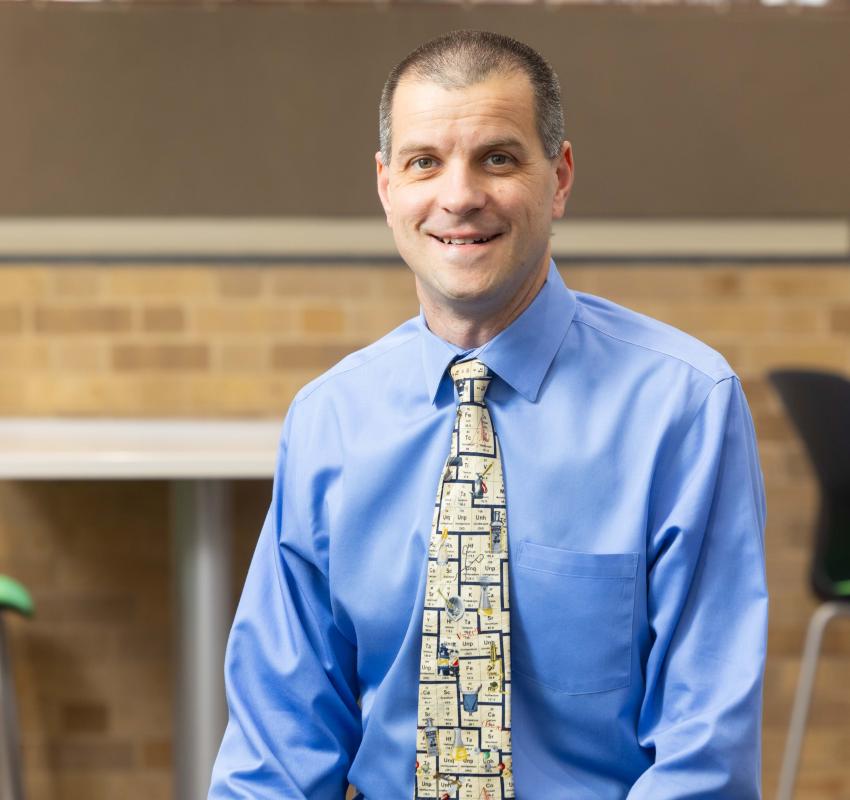
Dwight Stoll
Dwight Stoll is Professor of Chemistry at Gustavus Adolphus College. In this role, he regularly teaches courses in Quantitative Chemical Analysis and Instrumental Methods as well as Introductory Chemistry. He has received both the Faculty Service Award, and the Faculty Scholarly Achievement Award from Gustavus.
Dwight has authored or co-authored more than 100 peer-reviewed publications and six book chapters in separation science and speaks internationally on the topic. He is co-editor of the book on “Multi-Dimensional Liquid Chromatography: Principles, Practice, and Applications”. He has also written the monthly “LC Troubleshooting” column for LCGC Magazine and co-hosts the “Analytically Speaking” podcast.
Dwight's primary research focus is on the development of two-dimensional liquid chromatography (2D-LC) for both targeted and untargeted analyses. Within this area he has made contributions on many aspects of the technique including stationary phase characterization, biopharmaceutical analysis, new 2D-LC methodologies and instrumentation, and fundamental aspects including re-equilibration in gradient elution liquid chromatography and analyte focusing. He regularly teaches short courses on chromatography and 2D-LC, including in venues such as Pittcon, EAS, and the international HPLC20XX series.
He is the 2011 recipient of LCGC’s Emerging Leader in Chromatography Award, the 2015 recipient of the American Chemical Society Division of Analytical Chemistry Award for Young Investigators in Separation Science, and received the Georges Guiochon Faculty Fellowship in 2017.
View more of his work on the Stoll Lab website.