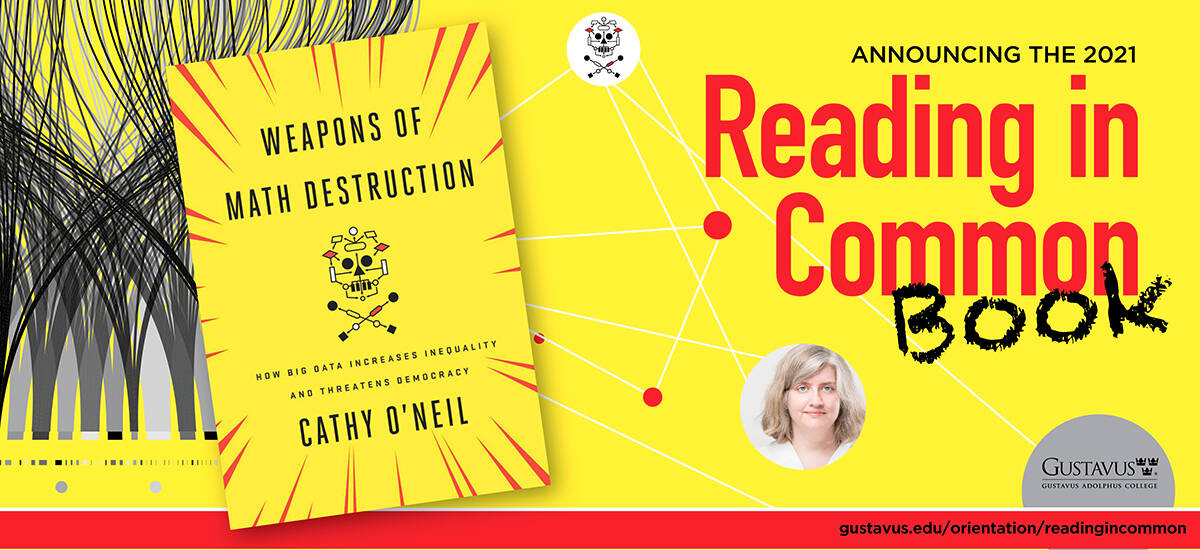
Reading In Common Program2021: Weapons of Math Destruction
About the Book
Technology advancements continue to make it easier for humans to gather information and to allow “decisions…[to be] made not by humans, but by machines. In theory, this should lead to greater fairness: Everyone is judged according to the same rules.” (Source: Penguin Random House) Although big data can improve processes and lives, the humans who write the mathematical models are imperfect, and those imperfections can materialize in the application of these algorithms. In Weapons of Math Destruction: How Big Data Increases Inequality and Threatens Democracy, Cathy O’Neil challenges us to face the negative consequences of algorithms by exploring the impact on “people who have been deemed unworthy in some way by an algorithm” (Source: E. Lamb, Scientific American Blog). In doing so, we begin exploring the primary question of the 2021 Nobel Conference, Big Data REvolution: “How is big data changing our lives, and what challenges and opportunities does this transformation present?”
About the Author: Cathy O'Neil
Cathy O’Neil is a mathematician who began her career in academia at Barnard College before working in the private sector. As a data scientist, she has not only evaluated algorithms, but has also created mathematical models for companies. O’Neil’s experiences led her to participate in Occupy Wall Street and to write Weapons of Math Destruction in order to increase awareness of the danger in putting too much trust in algorithms.
O'Neil “earned a Ph.D. in mathematics from Harvard and taught at Barnard College before moving to the private sector, where she worked for the hedge fund D. E. Shaw. She then worked as a data scientist at various start-ups, building models that predict people’s purchases and clicks. O’Neil started the Lede Program in Data Journalism at Columbia and is the author of Doing Data Science. She is currently a columnist for Bloomberg View.” (Source: Penguin Random House)
Learn more by reading the author’s blog, mathbabe.
Reading in Common Events:
Book Discussion
Date: during new student orientation in Fall 2021
Location: to be announced
Nobel Conference 57
Big Data REvolution
October 5 & 6, 2021
Gustavus Adolphus College
What do first-year students need to do?
- Purchase the book and actively read it before arriving on campus.
- Take notes.
- Highlight passages you think are important.
- Be prepared to discuss the book with your FTS/CUR-100 faculty and peers during the fall semester.
Obtaining Your Copy
Purchase a paperback copy or an ebook of Weapons of Math Destruction from The Book Mark - our campus bookstore. The Book Mark is located on the lower level of the Jackson Campus Center.
Goals and Aims of the Program
- Encourage intellectual interaction among students in conjunction with faculty
- Welcome students to the academic life of Gustavus
- Facilitate a shared academic experience for all students
- Emphasize reading as a significant component of the college experience
- Tie together transition and integration experiences of first-year students
- Provide opportunities for first-year students to explore issues and ideas relevant to our community and our world
- Connect to the Nobel Conference theme
How is the Reading In Common Program used?
All first-year students, Peer MALTs, First-Term Seminar Faculty, and Three Crowns faculty teaching first-year courses read the book over the summer. These students and faculty meet during orientation to discuss the book. The book is often used as a reference or resource in students' First-Term Seminar (FTS).
How is the book selected?
Books are chosen based on their literary quality, reading manageability (college level reading but not too long), interdisciplinary nature, and connection to the Nobel Conference theme. Books are recommended by members of the Gustavus community (e.g., faculty, staff, students) and vetted by the Nobel Conference Planning Committee, who sends recommendations to the FTS Director. After gathering additional feedback from other campus constituents, as needed, the FTS Director makes the final decision.
History of the Program
The Reading In Common Program began in the 2000–2001 Academic Year. Books in the Reading In Common Program have included:
- 2020: Mom's Cancer by Brian Fies
- 2019: While Glaciers Slept: Being Human in a Time of Climate Change by Dr. M Jackson
- 2018: The Good Food Revolution: Growing Healthy Food, People, and Communities by Will Allen and Charles Wilson
- 2017: Frankenstein by Mary Shelley
- 2016: Between the World and Me by Ta-Nehisi Coates
- 2015: The Immortal Life of Henrietta Lacks by Rebecca Skloot
- 2014: Where Am I Wearing?, Where Am I Eating? by Kelsey Timmerman
- 2013: A Pearl in the Storm by Tori Murden McClure
- 2012: The Other Wes Moore by Wes Moore
- 2011: The Wolf at Twilight by Kent Nerburn
- 2010: Hotel on the Corner of Bitter and Sweet by Jamie Ford
- 2009: Enrique's Journey by Sonia Nazario
- 2008: Chinese Lessons: Five Classmates and the Story of the New China by John Pomfret
- 2007: Mountains Beyond Mountains by Tracy Kidder
- 2006: Honky by Dalton Conley
- 2005: The Kite Runner by Khaled Hosseini
- 2004: When the Emperor Was Divine by Julie Otsuka
- 2003: The Things They Carried by Tim O'Brien
- 2002: The Legacy of Luna by Julia Butterfly Hill
- 2001: The Chosen by Chaim Potok
- 2000: The Samurai's Garden by Gail Tsukiyama