

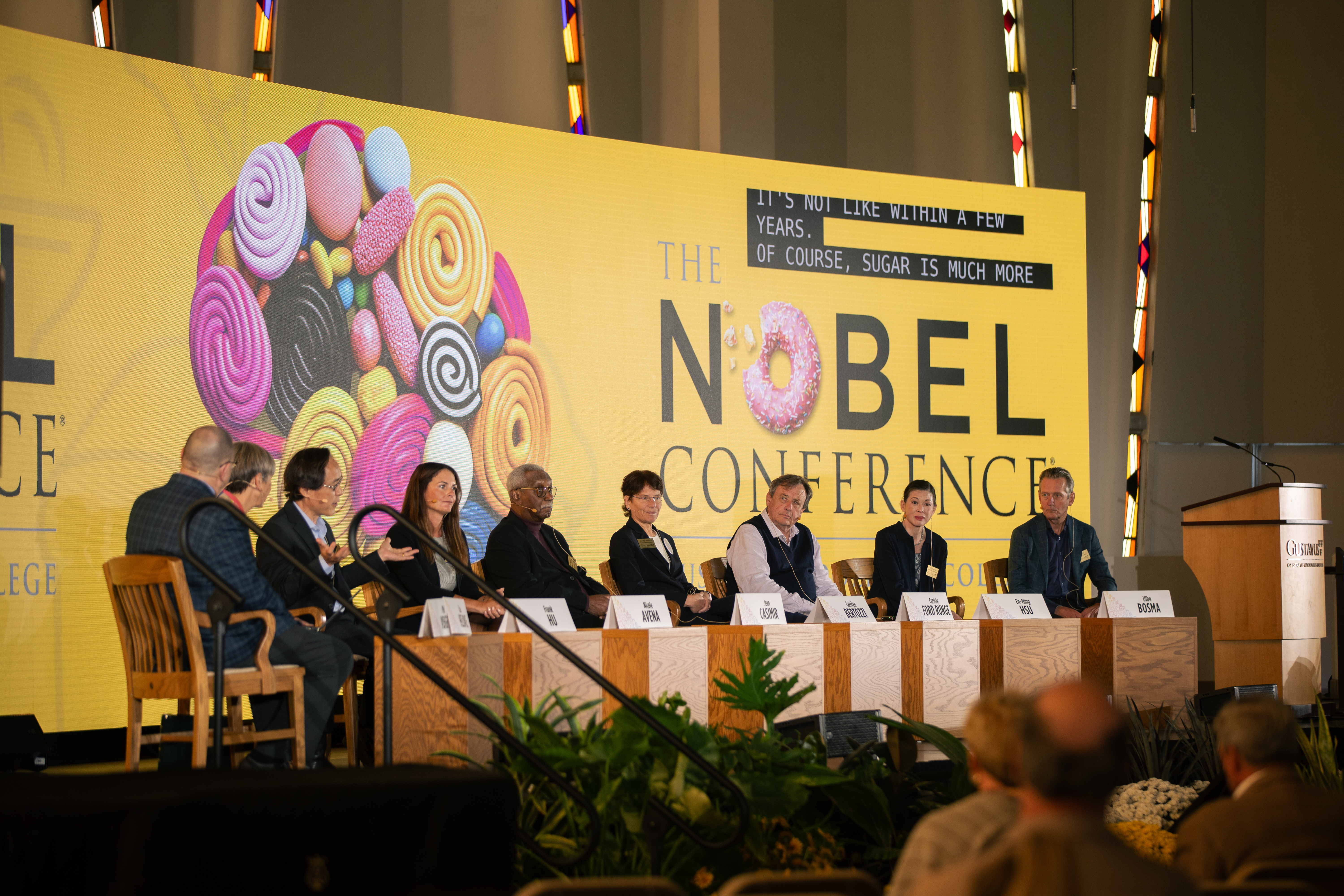
Gustavus connects undergraduate student liaisons with top scholars presenting at the Nobel Conference.
Imagine walking into the Gustavus Market Place and sitting down to have dinner with a Nobel Laureate. At Gustavus, this isn't just a hypothetical scenario: it is a reality through the annual Nobel Conference. The Nobel Conference is the only academic event in the United States authorized to use the prestigious Nobel name, underscoring its commitment to high-level scholarly discourse. Every year since 1965, the campus transforms into a global hub of intellectual exchange, offering undergraduate students unprecedented access to some of the greatest minds in the world.
For Gustavus students, the conference is a chance to build an extraordinary resume and proof of the tangible, high-level opportunities that make a Gustavus education a profound investment.
The flagship experience for students participating in the Nobel Conference is the student liaison program. Open to all majors—from exercise science to philosophy—the program selects 20 undergraduates each year to serve as personal hosts for visiting dignitaries, including Nobel Laureates, MacArthur "Geniuses," and Fields Medal winners.
Conference Director and Professor of Communications Studies Phil Voight recalls a moment with a student liaison following a luncheon on the Hill with Carolyn Bertozzi, a chemist who won the 2022 Nobel Prize in Chemistry. "She came up to me and said, 'I can't believe I just had lunch with a Nobel Laureate,'" Voight says. "And I'm like, 'Yeah, think of everyone who wishes they were in your shoes right now.' To me, that kind of experience is exactly what it means to go beyond."
These casual encounters can even turn into career-defining doors opening.
When renowned sleep researcher Mary Carskadon visited campus in 2024, she met with the tennis team to break down the science of adolescent sleep and athletic performance, giving student-athletes practical guidance on how to optimize timing, blocking sleep, and resting before big matches. This interaction led to an impromptu offer right from the stage: "Any Gustavus student who wants to come to Brown University and work in the summer at the E. P. Bradley Adolescent Sleep Lab, I’ll hire you. Just reach out to me."
Lauren Rocheford ‘26, one of the student liaisons assigned to Carskadon, seized the opportunity. She worked at Brown that summer, and Carskadon ultimately encouraged her to stay on before medical school.
What sets the Nobel Conference apart from typical campus lecture series is its deliberate integration into student life. Every visiting expert’s contract requires them to reserve dedicated blocks at the end of each day specifically to meet with Gustavus students in intimate, small-group settings.
These interaction blocks are tailored directly to academic departments and student cohorts. For the Nobel Conference held in October of 2026 on the topic of the Mississippi River, Dr. Solomon David, pioneer gar researcher, will meet with education majors to discuss the critical skill of communicating complex science. Similarly, when Jean Casimir, world-renowned scholar and former Haitian Ambassador to the United Nations, came to campus in 2025 to present a talk on sugar’s role in politics and culture, the entire French department reserved a dedicated session so every French major could learn from his insights firsthand.
For students looking to understand event execution and leadership, Gustavus offers a specialized SigX course focused entirely on running the Nobel Conference. The course equips students with practical skills in high-level event planning and audience engagement, giving them a tangible credential alongside their academic degree.
While the conference bears the Nobel name, its reach extends across the entire liberal arts spectrum. Programming frequently features art gallery openings, dance performances, music, and poetry readings designed to engage every discipline.
Voight emphasizes that scientific literacy is essential regardless of a student's ultimate career destination. "Let's say you go work for Hormel or 3M in one of their many departments," Voight says. "Your role might involve science, so you've got to be scientifically literate. Plus, you've now had these great opportunities to have a one-on-one connection with someone at this high of a level."
Whether students are seeking career mentorship from international leaders or simply sharing a meal with pioneers like Human Genome Project contributor Craig Venter, the Nobel Conference ensures that Gustavus undergraduates do not observe history from the back of an auditorium—they sit at the table with the people making it.

