

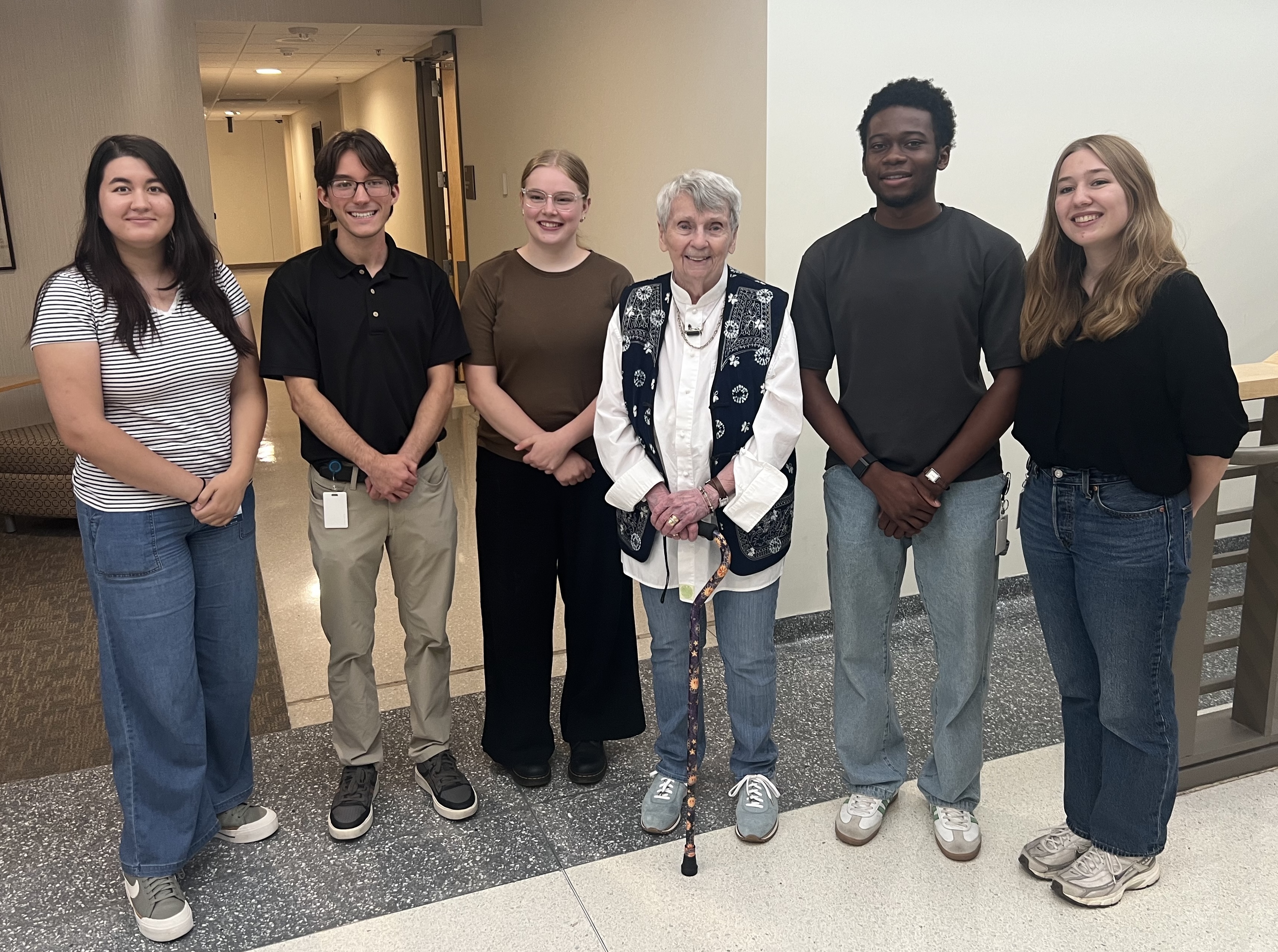
Thanks to the generosity of a 1951 alum, up to five Gustavus students will have the opportunity to secure an internship at the premier research institution.
Over the summer, five Gustavus students spent 10 weeks as research interns at the Hormel Institute in Austin, Minn. With an endowment from Ann Basset ʼ51, the opportunity was completely funded and will continue to be fully funded for up to five students every year.
The fully immersive experience accepts around 20 undergraduate students from across the country based on their high level of academic achievement, recommendations from academic leaders, college majors, and plans to pursue careers in science-related fields.
The internship allows students to contribute to biomedical research, while growing as communicators and researchers. Students often arrive wondering what research in a real-life setting looks like — and leave with a clearer sense of their future.
By the end of the internship this year, “Hormel felt like home,” says Iddris Larry ʼ27, who was one of the five Gustavus students chosen to participate in the 2026 summer research program.
Opportunity made possible
The Hormel Institute is an independent biomedical research center just 90 miles southeast of Gustavus. Founded in 1942, it’s home to some of the world’s most cutting-edge research technologies and expert scientists.
With connections to the University of Minnesota, the institute started the SURE Internship Program (Summer Undergraduate Research Experience) about 20 years ago. The 10-week paid summer internship allows college students to work with scientists on biomedical and cancer-related projects to expand their knowledge of basic research, gain firsthand lab experience, and learn about equipment and techniques that are generally not available in undergraduate academic programs.
“Part of their mission at the Hormel Institute is to train the next generation of scientists,” says Amanda Nienow, director of undergraduate research at Gustavus and a professor in chemistry.
Though a few Gustavus students have participated in the SURE program in the past, conversations about a formal partnership between the college and the institute began in 2023. With some funding secured, three dedicated Gustavus student placements were made in 2024 and another three in 2025. In 2026, funding for five students was secured thanks to the philanthropic generosity of Basset.
Inside the lab
Each of the five students from Gustavus chosen as SURE interns were assigned to different research labs at the institute:
- Arwen Baer ʼ26, a double major in psychological sciences and philosophy, studied structural biology and virus trends in the Ben Liu Lab.
- Olivia Hagestuen ʼ26, a biology major, looked at primary cilia in skin cancer as part of the Zhang Lab.
- Connor Johnson ʼ28, a biochemistry and chemistry double major with a minor in music, focused on immunology and immunotherapy in the Verma Lab.
- Iddris Larry ʼ27, a biochemistry and molecular biology major, researched primary cilia in liver cancer in the Gradilone Lab.
- Teagan McCarty ʼ27, a biology major with minors in chemistry and statistics, studied trends in virus structure in the Reddy Lab.
More than lab work
In addition to research experience, SURE students participate in weekly professional development courses and present in a symposium at the end of the internship.
Throughout the summer, they have additional opportunities to share their research with the broader Austin community, which has strengthened their public speaking skills. “Presenting to a different audience helped me find other angles to explain my research,” says Teagan, who was one of a select number of interns to speak to the Rotary Club in Austin.
“These students are developing not just lab skills, but communication skills and other soft skills that'll help when they go into the job market, graduate school, or medical school,” explains Nienow.
The students learn not only how to ask scientific questions but how to explain why those questions matter.
The power of community and mentorship
Because each lab accepts only one or two interns, each student has a fully accessible and immersive opportunity. “The Hormel Institute was a good way to see if this is what I want to do,” says Connor. Stepping into his first research experience, he noted that he “didn't just feel like an intern where they make me do the dishes. I was like a peer.”
Students work alongside a team that includes a principal investigator, PhD students, postdoctoral candidates, and other scientists. Mentorship isn’t just a perk, but a given. Interns are encouraged to ask questions about their research or career opportunities and attend lab meetings with other departments.
Outside of the lab, Gustavus students built relationships with the other interns, who lived in the shared housing. “It was great getting to know all these people who were at the same point in life to talk about our goals and future paths,” says Teagan.
Discovering what comes next
Many of the Gustavus students went into their internship with the same question: Will I like this? For some, they became more interested in research.
“I grew up in Ghana and took care of my granddad when he was sick, so my knowledge of science was being in a hospital,” says Iddris, who aspires to become a surgeon. At Gustavus, his lab courses introduced him to the science behind treating cells. Hormel showed him how science works from scratch. “I saw how the solutions researchers find in the laboratory can lead to a drug or a cure,” he explains.
Others discovered a different answer. “Well, I don't want to do research,” laughs Olivia. “But it was a great experience to figure out this is not for me. I learned skills that I wouldn't be able to in a normal undergraduate research setting, and every single skill is transferable.”
That’s the point. An internship isn’t necessarily to confirm a career path, but to discover new possibilities. “It’s a nice chance for people to test the waters,” adds Basset.
The Gustavus-Hormel connection
As students from a liberal arts college, the interns felt as if they were already set up for success walking into the Hormel Institute. “I was less out of place transitioning from a small, close-knit college to a small, close-knit institution,” says Connor.
Much of Arwen’s research involved writing, something she felt empowered to do since many of her classes at Gustavus are interdisciplinary.
Gustavus students are accustomed to think critically, ask questions, and interact with their professors and peers. “We were struck by the similarities between our educational approach here and at Hormel,” says Nienow. “They’re really helping students develop the best versions of themselves in a caring, supportive, yet challenging environment.”
The skills learned over the summer even translated into their fall semester classes. “I went into this internship with one intro to biology course,” says Arwen. “I’m now taking cell and molecular biology, and I'm able to help the people in my lab understand our material because it's the work I did over the summer.”
Making the opportunity possible
Basset, who was pre-med in college but chose another career path, liked the idea of this partnership with Gustavus and the Hormel Institute because it would give future students the chance to do what she did: change their minds.
Through the creation of The Ann Komatz Basset ’51 and Gene Basset Endowment Fund for Student Scientific Research, funding is now in place to support up to five Gustavus SURE interns each year.
Basset had the opportunity to get to know this year’s five Gustavus SURE students over the summer. “Their aspirations are all a little bit different. But they amaze me,” she says. “And that's what makes it really worthwhile, is knowing that maybe you can give somebody a leg up along the way in what they're aspiring to.”

