Nick EstesNobel Conference 62
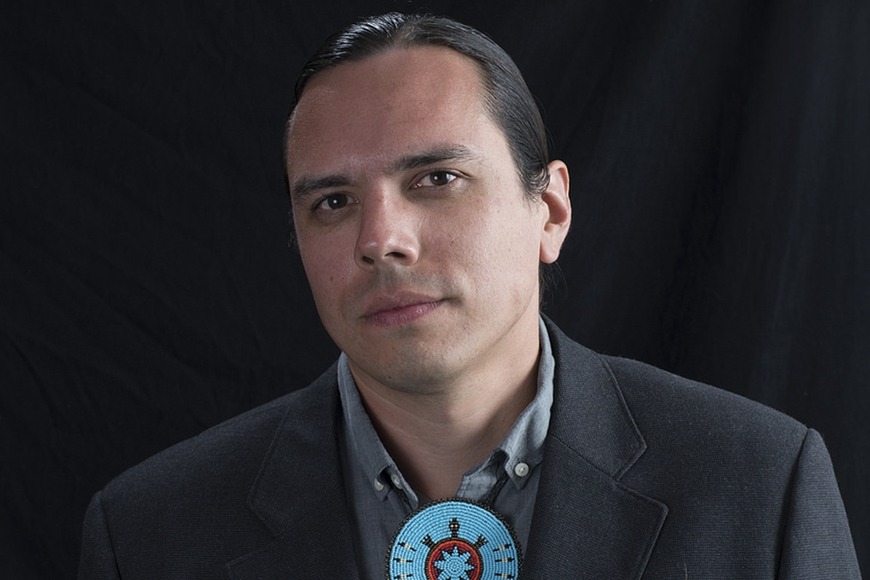
Nick Estes
Enrolled Member of the Lower Brule Sioux Tribe in South Dakota and Associate Professor in the Department of American Indian Studies at the University of Minnesota
At the Edge of Empire: The Mississippi River, Settler Colonialism, and the Oceti Sakowin
In 1787, the Mississippi was the Western-most boundary of the fledgling United States. That included the lands Dakota people called Mni Sóta Makoce (pronounced mni-SOH-tah mah-KOH-chay). The river itself served as a tool for American explorers and settlers to make economic and military inroads into the region.
Understanding the history of conquest is essential for making sense of the recent federal invasion of Minnesota. At the confluence of the Minnesota and Mississippi rivers was the Dakota site of emergence known as Bdóte. It was here that Americans built Fort Snelling, which is today home to the ICE regional headquarters. This talk examines the history of militarization of the Mississippi River in Mni Sóta Makoce and how it facilitated settler colonialism and westward expansion. This talk also looks at how Indigenous resistance challenges not only the colonial history of the Mississippi River but also a future premised on justice.
Biography
Nick Estes is an Associate Professor in the Department of American Indian Studies at the University of Minnesota, the oldest American Indian Studies department in the United States. A historian, journalist, and community organizer, Dr. Estes has emerged as one of the most influential voices documenting Indigenous resistance movements and articulating visions of decolonization rooted in centuries-old traditions of struggle for land, water, and sovereignty.
Dr. Estes received his PhD in Indigenous Oral Histories and Colonialism from the University of New Mexico in 2017. His research focuses on Indigenous histories with emphasis on decolonization, oral history, U.S. imperialism, environmental justice, anti-capitalism, and the Oceti Sakowin (the Seven Council Fires of the Dakota, Nakota, and Lakota peoples). He previously served as American Democracy Fellow at the Charles Warren Center for Studies in American History at Harvard University (2017-18) and taught in the American Studies Department at the University of New Mexico before joining the University of Minnesota faculty in 2022.
Dr. Estes is the author of the award-winning book Our History Is the Future: Standing Rock Versus the Dakota Access Pipeline, and the Long Tradition of Indigenous Resistance (Verso, 2019), a groundbreaking work that places the 2016-17 Standing Rock movement into profound historical context. The book traces two centuries of Indigenous resistance along the Missouri River (Mni Sose)—from early fur trading forts and the Indian Wars through the devastating Pick-Sloan dam projects, the rise of the American Indian Movement, and international Indigenous rights campaigns—to illuminate how the #NoDAPL movement emerged from deep traditions of water protection and anti-colonial struggle. Under the banner “Mni Wiconi” (Water is Life), the Standing Rock encampment grew to become the largest Indigenous protest movement of the 21st century.
Our History Is the Future has received numerous honors including the 2023 Gustave O. Arlt Award in the Humanities from the Council of Graduate Schools, the 2020 PEN Oakland/Josephine Miles Literary Award, the 2020 One Book One Tribe Book Award from the First Nations Development Institute, and selection as the 2022 One Book South Dakota Common Read.
Dr. Estes co-edited with Jaskiran Dhillon Standing with Standing Rock: Voices from the #NoDAPL Movement (University of Minnesota Press, 2019), and he is the co-author with Melanie K. Yazzie, Jennifer Nez Denetdale, and David Correia of Red Nation Rising: From Bordertown Violence to Native Liberation (PM Press, 2021).
In 2014, Dr. Estes co-founded The Red Nation, an Indigenous resistance organization committed to liberation of Native peoples from capitalism and colonialism. He serves as lead editor of Red Media, an Indigenous-run nonprofit media organization that publishes books, videos, and podcasts, and co-hosts The Red Nation podcast, which has been featured by The New York Times, CNN, and Al Jazeera and is used in high school and college classrooms nationwide. He is a member of the Oceti Sakowin Writers Society, a network of Dakota, Nakota, and Lakota writers dedicated to defending and advancing Oceti Sakowin sovereignty, cultures, and histories.
Dr. Estes’ writing has appeared in The Guardian, The Intercept, Jacobin, Indian Country Today, The Nation, NBC News, High Country News, The New Yorker, and The Funambulist Magazine. He was named a Lannan Literary Fellow for nonfiction (2019), a Marguerite Casey Foundation Freedom Fellow (2020-2021), and a National Archives Distinguished Scholar at Boston University (2022-2023).