

Department
Business and Economics
Title
Associate Professor
Contact
Curriculum Vitae
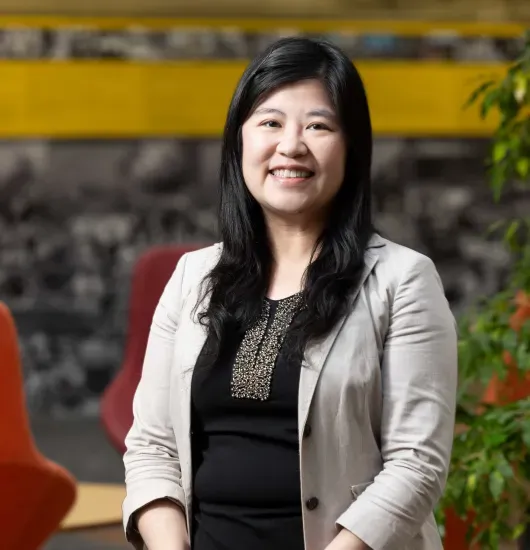
Dr. Shu-Ling Wang is an associate professor of Economics. She joined Gustavus in 2016 after a two-year appointment at The College of Wooster. Her teaching interests include Intermediate Macroeconomics, Money and Banking, International Finance, Public Finance, and Principles of Economics. As an active instructor in an interactive and interdisciplinary liberal arts environment, she enjoys developing and experimenting with innovative pedagogies to enrich students’ learning experiences. She also values mentoring undergraduate research that fosters critical and independent thinking. At Wooster, she advised several year-long senior independent studies, and at Gustavus, she offers writing-in-the-discipline courses in economics and mentors class-based research projects. In October 2023, her Money and Banking students’ paper titled “The Asian Crisis of 1997” won third place in the Economic Communication category of the Minnesota Economic Association (MEA) Undergraduate Paper Contest. In 2025, Dr. Wang served as a faculty panelist at the MAYDAY! Peace Conference at Gustavus, participating in the teach-in model addressing issues of peace, human rights, and social justice. More recently, she served on the Nobel Conference '63 Planning Committee (theme: AI and Human Agency).
Dr. Wang’s research focuses on Macroeconomics, Monetary Economics, and International Finance. She studies fiscal and monetary policy issues—such as fiscal stimulus, public debt, tax policy, income distributional effects, and monetary policy, using dynamic stochastic general equilibrium (DSGE) models with representative or heterogeneous agents. Her papers have been published in the Journal of Macroeconomics, Review of International Economics, and Economic Modelling. She received the Mansergh Faculty Scientific Research Award at Gustavus in both 2022 and 2025. Her recent project examines the debt-financed stimulus effects in a high-debt economy without monetary independence, considering different schemes and speeds of debt adjustment in a two-sector New Keynesian model. Future projects will examine the redistribution effects between savers and hand-to-mouth agents of debt-financing policies. She regularly presents her work at the The Midwest Economics Association, Canadian Economics Association, Western Economics Association, and Liberal Arts Macroeconomics conferences.
In addition to her research, Dr. Wang actively contributes to professional service. She serves as a reviewer for the Journal of Macroeconomics, Economic Modelling, Contemporary Economic Policy, Cambridge University Press, and the Bulletin of Economic Research. She has also served on the steering and program committees for the Liberal Arts Macroeconomics Conference and was a member of the Board of the Minnesota Economic Association. In 2025 she served as a mentor and a panelist for junior women economists at the CeMENT workshop sponsored by the AEA at the Federal Reserve Bank of Chicago.
Beyond academia, Dr. Wang is a mother of three children. She enjoys architecture, art, photography, and music. Her favorite architects include Frank Lloyd Wright, Louis Sullivan, and Zaha Hadid. She is also inspired by the works of Georgia O’Keeffe, Edward Hopper, and Claude Monet. A musician herself, she plays the piano, violin, and pipa (a Chinese lute). Her favorite composer is Johann Sebastian Bach of the Baroque period.
B/E-107: Principles of Economics
B/E-382: Money & Banking
B/E-282: Intermed Macroecon
B/E-384: Int'l Trade & Finance