You are here: Chaplain's Office / Christ Chapel
 

Christ Chapel


Contents: Introduction - Granlund Doors and Sculptures - Organ and Other Instruments - Font - Candelabra - Taizé Cross -

Christ Chapel

Introduction
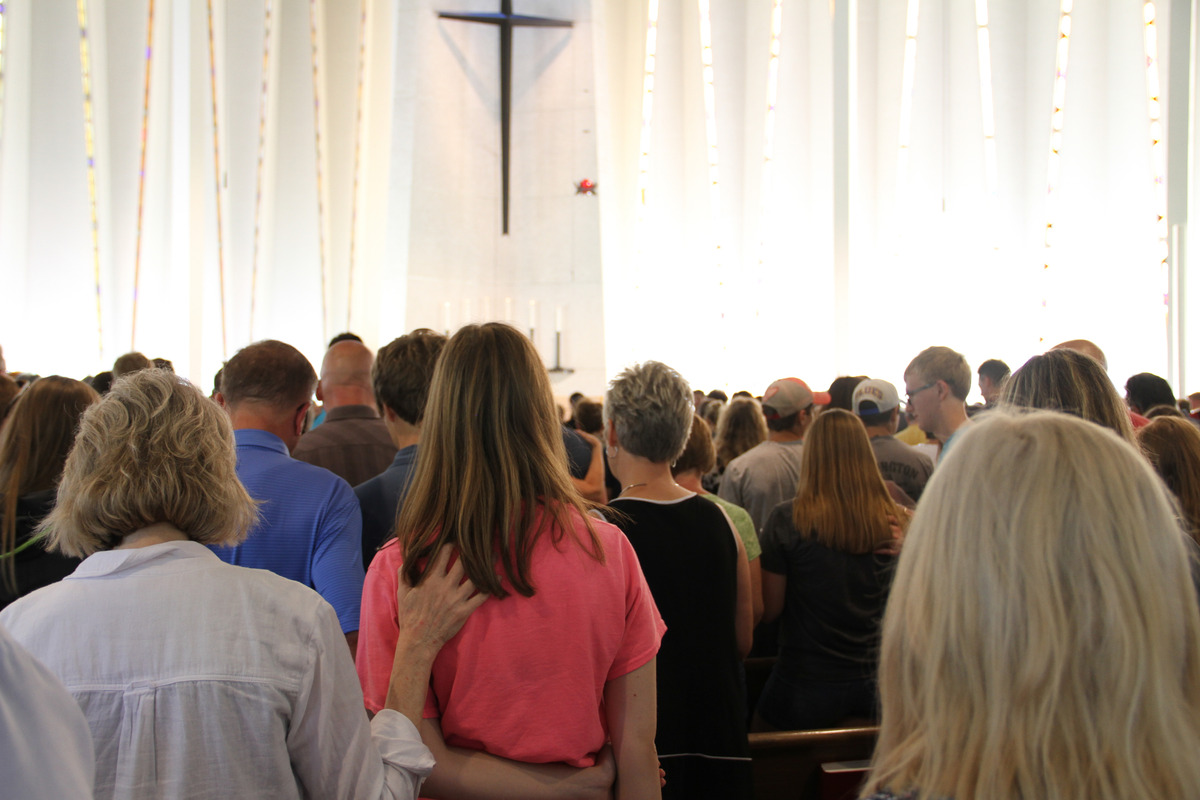
Christ Chapel was dedicated on January 7, 1962, under the presidency of Edgar M. Carlson. It is located in the center of campus as a symbol of the central place of faith at this church-related college. Glowing like a jeweled crown at night, reflecting the light of the sun in the morning, it is the Tent of Meeting for the Gustavus campus and extended family. Its walls, shaped like spires and shafts, remind us of the upward movement of prayer and the descending movement of revelation. It is a chapel with two kinds of windows, the colored panes which are the jewels of this crown and the clear glass. The light from within shines out onto the life outside, and the light from the world enters into the intimacy of worship. It is a place where we learn the subtle discipline of listening to other voices - to one another and to God.

The ground breaking for Christ Chapel was held March 2, 1959. Clement Attlee, former Prime Minister of Great Britain was among other leaders of the Church and State gathered for the event. Construction was completed in the fall of 1961, and the first service held was the opening convocation of Gustavus' one hundredth academic year on September 10, 1961.

The plans for the Chapel were prepared by the architectural firm of Setter, Leach & Lindstrom of Minneapolis. Harry Gerrish was the designer, the George E. Carlstrom Construction Company of Mankato was the general contractor, and Harold Rhykus was the construction superintendent.

The cross at the tip of Christ Chapel's spire is 187 feet above ground level. Over 350 tons of steel were used to erect the building. The walls were formed using 88 pre-cast triangular concrete panels, each weighing nine tons, finished with quartz aggregate on the outside and plaster on the inside. Each panel is 50 feet high, and each exterior wall measures 112 feet wide. There is room enough for 1500 people inside the Chapel - 1200 on the main floor and 300 in the balcony.

Stained Glass Window The lower portions of the stained glass windows, which separate the giant concrete panels and run the full height of the building, contain contemporary forms of historic symbols: fish, anchors, flames, stars, doves, uniting chains, ships, sacramental cups and wafers, trumpets, serpents and cups of incense. When the sun shines through them, they cast colorful patterns along the walls and throughout the building.

Each of the four entrances to the Chapel are graced with bronze sculptures and friezes by Paul T. Granlund. The four narthexes honor four Gustavus presidents: Eric Norelius, founder of the College; Andrew Jackson, 1863-1876; P. A. Mattson, 1904-1911; and O. J. Johnson, 1913-1942.

This page is filled with pictures and text recalling the history of Christ Chapel, as well as the art and instruments which furnish the Chapel today.

Back to top

Granlund Doors and Sculptures
Bronze pieces created by Gustavus Adolphus College sculptor-in-residence Paul T. Granlund enhance Christ Chapel and its surroundings both artistically and theologically.

West Entrance: Old Testament Door Within the west entrance, the Old Testament Door, is a sculptural frieze portraying the stories of Adam and Eve, Noah, Abraham, Jacob, Moses, Joshua, David, Solomon, Elijah, Josiah and finally, at the center, Isaiah and John the Baptist pointing to the Lamb of God. The outside door carries a creation motif.

North Entrance: Christ Door North Entrance: Inside Panels

The handles of the north entrance, the Christ Door, are themselves a part of the sculptural Christian timepiece of which the figures, running counterclockwise, are the seven major points of the Creed's Second Article: crucified, died, buried, descended, rose again, ascended and reigns. The figures are unified by a tree lifeless on one side, symbolizing dormancy and death, with foliage emerging on the other side, symbolizing new life in Christ. Inside panels treat the themes of Baptism and the Lord's Supper.

East Entrance: New Testament Door The east entrance, the New Testament Door, bears sculpture that is a visual metaphor for the scriptural passage, "I am the vine and you are the branches." The four branches reflect the seasons of life. Inside panels celebrate the birth of the church - the apostle Paul and the Pentecost story - as well as the lives of New Testament and Modern Saints, including Mother Teresa, Albert Schweitzer, Teilhard de Chardin, Johann Sebastian Bach, Gustav II Adolph, Martin Luther, Johannes Gutenberg, St. Jerome, Hildegaard von Bingen, Polycarp, St. Ansgar, King Bjorn, St. Francis of Assisi, St. Birgetta with her daughter Catherine, Eric Norelius, Edgar Carlson, Campanius, Muhlenberg, Martin Luther King Jr., Dag Hammarskjold, and Raold Wahlenberg.

South Entrance: Hope Door The south entrance, the Hope Door, depicts the final moment of existence. Free yet united figures of the family of believers, those attracted by Christ's righteousness, float toward a triumphant, welcoming Christ. Below, those repelled by righteousness recede into isolation in solid bronze.

Granlund Sculpture: Crucifixion Granlud Sculpture: St. Francis Four Granlund sculptures grace the Christ Chapel grounds. To the west, Palindrome, the memorial fountain honoring Bishop Melvin Hammarberg, says in classic Greek characters, "Wash your iniquities, not only your face." Crucifixion, on the Eckman Mall side of the chapel, is a gift from former Gustavus Adolpus College President Edward Lindell and his wife Patricia. To the east, Luna Moth Matrix, a metaphor of the promise of resurrection and renewal, celebrates the membory of Douglas Sandberg. On the southwest corner of the chapel lawn, St. Francis dances on the moon and looks through the sun/Son at the risen Christ. This sculpture, given by the Anderson family in memory of Ren and Sylvia Anderson who directed the Office of Public Relations, is based on the Canticle of Brother Sun.

Back to top

Organ and Other Instruments
The organ in Christ Chapel was originally built by Hillgreen-Lane at the time the Chapel was built. It has been significantly altered in the last 30 years. These renovations, carried out by David Engen and more recently by the Hendrickson Organ Company of St. Peter, include a new console with solid state combination and relay, moving several ranks of pipes from an antiphonal position in the basement into the main organ above the balcony, restructuring the Swell mixture, and extensive repairs following the tornado of 1998. It currently contains 55 speaking ranks of pipes, played from a four-manual console, and has a preparation on the new Great chest for a mounted Kornet V stop.

Chapel Organ The Chapel also houses a small portative organ of three stops on one manual which is used for accompanying and especially for continuo playing in Baroque compositions.

A Steinway B (7') piano, in addition to the four-octave set of Schulmerich handbells, rounds out the primary musical instruments in Christ Chapel.

For photos and more information about the organs at Gustavus, see the following website: http://gustavus.edu/~dfienen/Organ/Organs.html

Back to top

Font
The Baptismal Font in Christ Chapel was done by Professor Donald Gregory, the original member of the art department at Gustavus. The inspiration for the font design came from the Swedish May Baskets his mother used to make. They were folded in fours, a shape which echoes the shape of the Chapel itself.

Back to top

Candelabra Candelabra
The candelabra was placed by former Gustavus President John Kendall in recognition of his father Leonard Kendall's contributions to the college and the chapel. Words near the votive candelabra in the Cathedral in Uppsala, Sweden also grace the Christ Chapel candelabra:

Ljus for Andra
Lägg en gåva och tand ett ljus.
Bed en kort bön, om du kan, för någon
du håller av, eller någon som behöver
se Guds ljus i sitt liv.
Light for Others
Make a gift and light a candle.
Pray a short prayer, if you can, for
someone you love, or someone who needs
to see God's light in his life.

Back to top

Taizé Cross Taizé Cross
The Taizé cross used in Christ Chapel is made from two posters that reproduce the icon of the crucified Jesus, painted by Brother Eric of Taizé, that is in the Church of Reconciliation in the Taizé Community of France. Gustavus carpenters created the wooden framework to which the posters are varnished so that the cross matches the rest of the wood in the Chapel. The Taizé cross icon is used as a focal point for the worship community at the weekly nighttime Taizé services held in the Chapel, as well as the occasional morning Taizé services held during daily Chapel. The Confer Family Chapel Fund made the purchasing of materials and labor for the Taizé cross icon possible.

Back to top


Did you know?

Schaefer Fine Arts Center is a two-building complex with art gallery space, art and music studios, two theaters, a dance studio, and a recital hall.

Women's Track and Field Posts Strong Second Place Finish At MIAC Outdoor Championships

The Gustavus women's track and field team finished second behind champion St. Thomas as the Minnesota Intercollegiate Athletic Conference (MIAC) Outdoor Track and Field Championships which were hosted by Hamline University in St. Paul. Three Gusties claimed individual championships and that group included Lisa Brown (javelin), Shanna Dawson (pole vault), and Kaelene Lundstrum (high jump).

Baseball Team Stays Alive In MIAC Tournament With 7-3 Win Over Hamline, Saturday's Game Moved Up To 11:00 AM

The Gustavus baseball team lost its first game in the MIAC Tournament to St. Thomas 11-3, but then rebounded with a 7-3 win over Hamline in the nightcap. The Gusties will now face St. Olaf on Saturday morning in the consolation final at 11:00 am. The game was originally scheduled for 1 pm, however with rain forecast for the afternoon, the starting time has been moved to 11 am in Dundas at Memorial Park.

Paul Magnuson Student Awards for Leadership and Service Announced

Five student leaders, three student organizations, and two student-led events were recognized on Wednesday, May 7 at the annual Paul Magnuson Student Leadership and Service Awards Program at Gustavus Adolphus College.

MIAC Women's Outdoor Track and Field Preview

The Gustavus women's track and field team will take participate in the MIAC Outdoor Championships this Friday and Saturday at Hamline University. The Gusties finished second at the outdoor meet a year ago and placed second at the indoor championships in March. Coach Tom Thorkelson's squad will attempt to use its talent and depth to sneak past St. Thomas into the top spot this year. The meet begins at 3:00 pm on Friday and then on Saturday, events begin at 4:00 pm.

Men's Track And Field MIAC Championships Preview

The Gustavus men's track and field team will compete in the MIAC Outdoor Track and Field Championships this Friday and Saturday at Hamline University. Senior pole vaulter Drew Hood and junior hurdler Tyler Geyen are ranked among the elite performers in the conference heading into the weekend championships.

 
Rate this page:
Gustavus Adolphus College 800 West College Avenue
Saint Peter, MN 56082 USA
WORK (PREFERRED) 507-933-8000
Contact Us
Employment
Privacy Policy
 
© Copyright 2008, Gustavus Adolphus College, All Rights Reserved