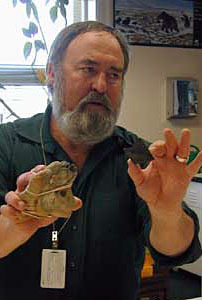
Dennis Stanford
Head of the Archaeology Division, National Museum of Natural History, Smithsonian Institution
Dennis Stanford will present on New World origins of humans, concentrating on the North Atlantic migration route where early humans followed the edge of the ice, hunting sea mammals and sea birds, and the newfound dominance of Clovis technology, essentially the basis of his and Bruce Bradley's Solutrean Solution Model, which holds that stone tool technology in prehistoric Europe influenced development of Clovis toolmaking culture in the Americas.
Dennis Stanford was raised in Rawlins, Wyoming, the son of William E. and Mary Stanford. His father started out with JCPenney, whose first store was in Wyoming, and later went on to open several women’s ready-to-wear clothing stores of his own. When Dennis was about 10 years old, he started finding Indian artifacts and developed an interest in Wyoming prehistory. During the summer between his junior and senior years in high school, a local construction worker excavated some mammoth bones and brought them to Dennis to identify. In turn, Dennis contacted the University of Wyoming, and paleontologist Paul McGrew and archaeologist G. [George] Agogino came to examine the finds. It turned out that the entire mammoth was there and in remarkable condition.
Agogino arranged for a Harvard archaeological team to excavate the site and young Stanford was able to work with the crew. A number of young people he met at the time are still among his close associates. Needless to say, he was excited about the excavations and decided to become a professional archaeologist. In 1961, Stanford enrolled in the University of Wyoming, but unfortunately the university did not offer a degree in anthropology, and there was but one anthropologist, William T. Mulloy, in the sociology department.
Professor Mulloy recognized something special in Stanford and worked with him one-on-one to help prepare him for graduate school. “Dr. Mulloy assigned me several books on a variety of anthropological subjects to read each week, and then gave me an oral test on the readings every Friday afternoon,” Stanford remembers. “He once told me that an archaeologist needs to be a jack-of-all-trades, but master of none. A diverse education, including studies in geology, biology, sociology, linguistics, and history, gives the student of anthropology an appreciation and understanding of the evolution of human societies and their relationship to the natural environment.” That individual attention and sound advice was, says Stanford, what gave him a competitive edge.
Following his undergraduate studies at the University of Wyoming, Stanford earned a master’s degree and Ph.D. in anthropology at the University of New Mexico in Albuquerque. Then, right out of school, he was offered a position with the Smithsonian, which had just initiated a program in paleo-Indian studies. There, he chose to devote his own research and career to early American prehistory; he’s been there ever since. Throughout the years he has held various posts, including curator, head of the division of archaeology, and chairman of the department of anthropology.
During the last several decades, Stanford has conducted fieldwork from Alaska to Monte Verde in Chile, where the oldest human remains in the Americas were found. Along the way, he has distinguished himself as one of the world’s leading authorities—not to mention one of the most thoughtful—on the peopling of both North and South America.
When Stanford started out, archaeologists and paleoanthropologists subscribed to the belief that the first people to arrive in America came by way of the Bering Land Bridge. Once here, according to that hypothesis, the new Americans independently invented their own stone projectiles for hunting, known now as Clovis points. Although the Bering Land Bridge hypothesis was untested, it was the accepted conventional wisdom and has long been deemed “as much a part of America’s cultural heritage as Yellowstone or Yosemite.”
After 30 years of digging in the field—in Alaska, the Arctic, and Siberia—evidence and proof of the hypothesis weren’t turning up. Stanford and his colleague, Bruce Bradley, now of the University of Exeter in the United Kingdom, however, uncovered something else—a distinct similarity between the Solutrean culture of Paleolithic Europe and the Clovis technology of North America. Although scholars in the past rejected such a notion of an historical connection between those geographically separated cultures, since they were separated temporally by 5,000 years and geographically by 4,000 miles of North Atlantic Ocean, continued research has a way of changing things. Stanford and Bradley put forth their Solutrean Solution Model, offering up a new migration route for America’s first immigrants—across the Atlantic Ocean from Southwestern Europe following the margin of the pack ice that bound all of the land masses closer together some 21,000 to 16,000 years ago. And, Stanford says, they took along their stone tool, hunting technology for the trip.
By this reckoning, the fluted Clovis points used for hunting in North America around 11,000 years ago were not developed independently as was previously theorized, but, Stanford says, evolved from the advanced flaking techniques of Solutrean technology, first developed in prehistoric Europe some 8,000 years earlier. This technology was named for the site in Solutré, France, where flint artifacts, made using the same and unique techniques used by Clovis flintknappers, were first discovered in 1866. While not everyone has embraced the Solutrean Solution, Stanford remains confident. “We have a new site called Miles Point, where we now have the oldest radiocarbon date in the United States—it’s on the Chesapeake Bay. That’s pretty exciting stuff.”
Stanford is one of the eight archaeologists suing the U.S. government to make the Kennewick Man available for study. The skeletal remains of this prehistoric man were found on a bank of the Columbia River near Kennewick, Washington, on July 28, 1996, and became embroiled in debates about the relationship between Native American religious rights, archaeology, and the U.S. government.
Stanford has authored or co-authored more than 100 articles, books, and book chapters. Among his books: Ice Age Hunters of the Rockies (University Press of Colorado, 1992), which he edited with Jane Day and to which he contributed an introduction and an article; Paleoamerican Origins: Beyond Clovis (Texas A&M University Press, 2005), which he co-edited with Rob Bonnichsen, Brad Lepper and Michael Waters; and Environment, Origins, and Population, Volume 3 of the Smithsonian Institution’s Handbook of North American Indians, for which he was an editor (Smithsonian, 2006). Earlier, he co-edited Pre-Llano Cultures of the Americas: Paradoxes and Possibilities with Robert L. Humphrey (The Anthropological Society of Washington, 1979).
Currently, Stanford is working on a book with Bradley about their theory of an early North Atlantic crossing and the Solutrean Solution Model.